
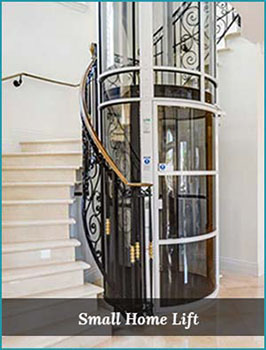
Residential Elevator is the commonly used term for a lift that is enclosed in a shaft and can travel vertically as much as 15 m (50 ft.). Also Known as Home lift/Bungalow Lift, there lifts are excellent means of vertical transport in multi storey homes. Home Elevators increase the value of your home while providing an easy way to carry groceries, laundry or anything else floor to floor. Gone are the days when home lifts were no more than dumbwaiters for carrying inventory of clothes or dishes, now a days home elevators are cocktail of luxury, technology, design and aesthetics which reflects your style statement and merge with the eloquence of your home.
Residential Elevators are fully customizable wherein you can have almost anything you imagine, from marble walls to stained glass, these home elevators are a unique expression of you! Residential elevator style range from the most basic, unfinished open platform to fully enclosed cabins with safety gates and interior finishes such as hardwood, ceramic tile, marble and granite. These use standard interior doors, so they blend in seamlessly with your home's decor. Nowadays, Wheel Chair Elevators, Home Elevators standard interior doors, so they blend in seamlessly with your home's decor. Nowadays, Residential Elevators come with fully automatic controls and tons of safety features like an emergency stop button, in-cab alarm, and a telephone jack that accommodates a standard household phone.
Residential Elevators are quickly becoming the next must-have amenity in a new home. Number of Residential Elevators is growing as builders and buyers discover the advantages:
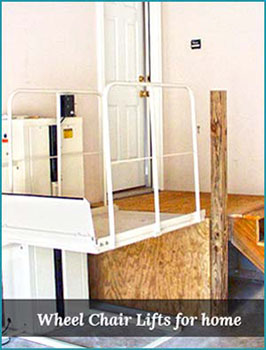
A residential elevator is less complex (and less-expensive) than an elevator in an office or high-rise apartment or condominium building. Commercial elevators are regulated provincially and must be licensed and regularly inspected. Residential lifts and elevators do not need licenses. Residential Lifts are low capacity lifts designed around 5-6 person whereas commercial lifts have higher capacity.
| ITEM | STANDARD | OPTIONAL |
|---|---|---|
| Drive | Geared Motor | Gearless Motor |
| Door | Manual | Automatic |
| Power | 440V AC/50 Hz/2 KW | 220V AC/50 Hz/3 KW |
| Lift Shaft | Civil Structure in Brick or RCC | Steel Structure Covered with |
| Cabin & Door Design | Powder Coated | Cement sheet/Glass |
| Control | Frequency Control ACV3F | Stainless Steel/Glass Panoramic |
| No. of Floor(Max. height) | Max. 5 floors (15 meters) | - |
Space Requirements for Home Lift
| Model | Capacity | Car Size | Lift Shaft (Internal) | Lift Shaft (External) | Door Size | Machine Room | ||||||
| Width | Depth | Width | Depth | Width | Depth | Width | Depth | Width | Depth | Height | ||
| LAGHU | 2 Person or 200 kg | 850 | 850 | 1220 | 1220 | 1400 | 1400 | 700 | 1900 | 1400 | 1400 | 2000 |
| ANUJ | 3 Person or 275 kg | 1000 | 850 | 1400 | 1220 | 1550 | 1400 | 800 | 1900 | 1600 | 1400 | 2000 |
| All dimensions in mm | ||||||||||||
© Apex Elevator 2017